


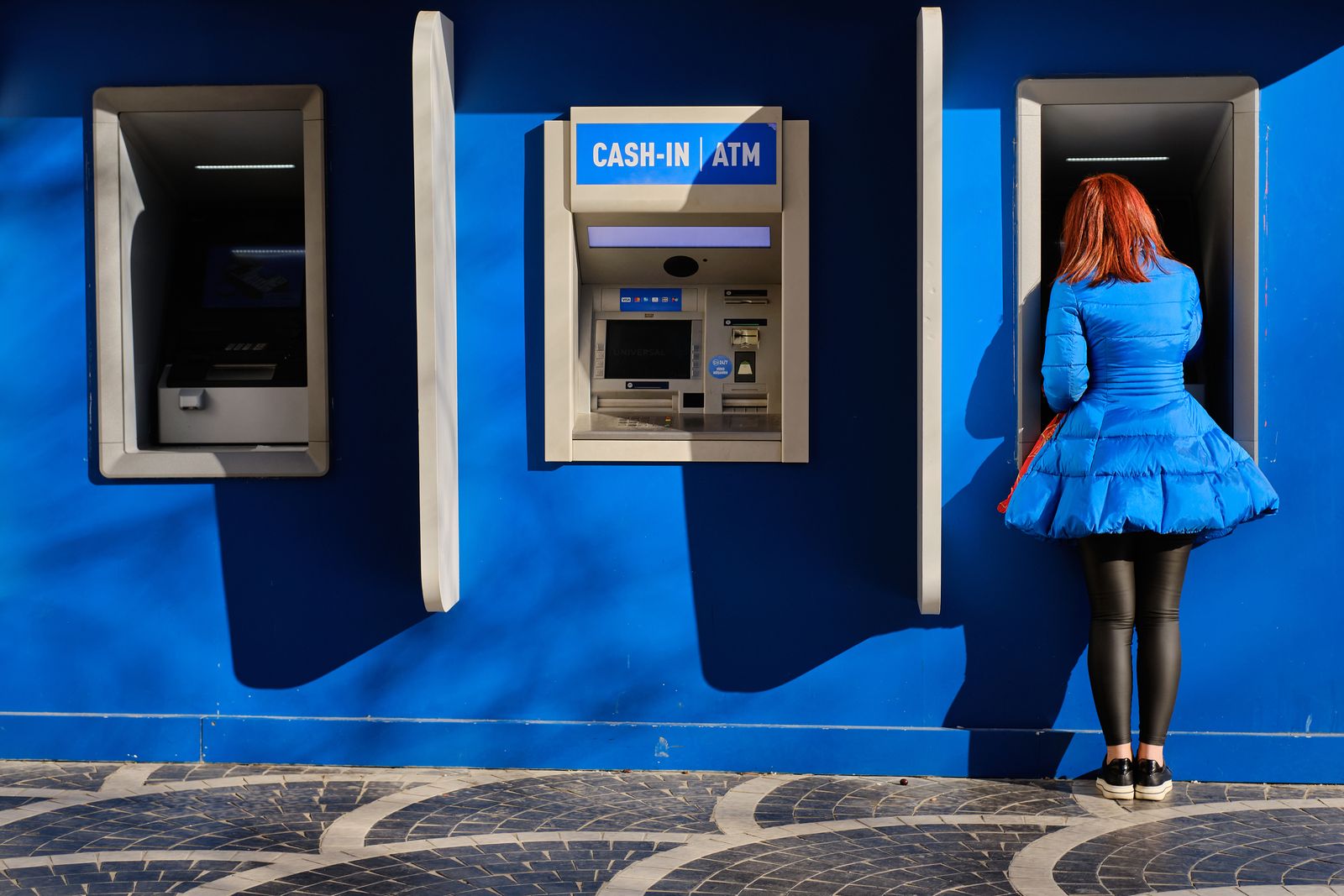
To avoid international ATM fees, use a card that doesn't charge foreign fees, pick an ATM run by a bank (ideally a partner of your bank), always choose the local currency when the screen offers to convert, and take out fewer, larger amounts. Most of the cost of an ATM withdrawal abroad comes from three fees and one currency trick. Once you know which is which, you can skip most of them. Here's how each one works and what you can do about it.
The 3 fees you can pay at an ATM abroad
One withdrawal can be charged up to three times: by the ATM, by your bank, and for the currency exchange. Here's who charges what.
1. The ATM operator fee (surcharge)
- A flat fee charged by whoever owns the machine, also called an access fee or surcharge.
- Independent ATMs that aren't run by a bank, such as the Euronet machines you see in many tourist areas in Europe, often charge one.
- This money goes to the machine owner, not to your bank.
- The screen should show it before you confirm. In the EU, the machine must clearly tell you its charges and the exchange rate when you withdraw (European Consumer Centre France: How much does it cost to withdraw money abroad?).
2. Your bank's foreign ATM fee (out-of-network fee)
- A flat fee your own bank charges when you use an ATM outside its network.
- Many banks charge it at home too, when you use another bank's ATM.
- It can apply even when the ATM itself charges nothing.
3. The foreign transaction fee (currency conversion fee)
- A percentage of the amount, charged by your bank (and sometimes passed on from the card network) to convert the currency.
- Unlike the flat fees, it grows with the amount you take out.
- On your statement it may appear as a "foreign transaction fee", "international transaction fee", "non-sterling transaction fee" or similar.
Your bank's fee schedule lists fees 2 and 3. Check it before you go, or ask your bank: "What do I pay to withdraw cash abroad, and do you refund other banks' ATM fees?"
The hidden extra: dynamic currency conversion
Many ATMs abroad offer to charge you in your home currency. You might see "Charge in USD?", "Accept conversion?" or two buttons: With conversion and Without conversion. This is called dynamic currency conversion (DCC). The ATM operator sets the exchange rate, and that rate is usually worse than the one your card network and bank would use. The European consumer organisation BEUC says the rate for paying in your home currency is "almost always worse" than standard exchange rates (BEUC: #WhichCurrency should I pay in?).
The rule is simple: always choose the local currency, or Without conversion. Your bank then does the conversion. The same goes for card terminals in shops and restaurants.
How to avoid ATM fees abroad: 8 ways
1. Check your card's fees before you travel
Find the foreign transaction fee and the foreign ATM fee in your bank's fee schedule or app. Some accounts have neither. Some refund the ATM operator's fee too. If you have more than one card, take the one with the lowest foreign fees for cash and keep another one as a backup.
2. Get a debit card without foreign fees
Some banks, credit unions and digital banks offer debit cards with no foreign transaction fee, and some of them also refund ATM fees worldwide. Read the details before you switch:
- Does the account only waive its own fees, or does it also refund the ATM operator's fee?
- Is there a monthly limit on free withdrawals, or a free amount, after which a fee applies?
- Are there conditions, like a minimum balance or a linked account?
- Does the card work in the countries you're visiting?
Open the account a few weeks before your trip, so the card has time to arrive.
3. Always pick the local currency
This is the easiest saving and needs no new card. Whenever an ATM or card terminal asks, choose the local currency, or Without conversion. If you're not sure what the screen means, cancel and start again at another ATM.
4. Use a bank's ATM, not an independent one
ATMs in or next to a bank branch usually charge less than independent machines in airports, train stations, hotel lobbies and busy tourist streets. Before you confirm, read the screen: it should show the operator's fee and any conversion offer. If the fee looks high, cancel and find a bank ATM nearby. Your bank's app can often show the nearest partner ATMs.
5. Use your bank's partner ATMs (Global ATM Alliance)
Some banks have partner networks abroad. The best known is the Global ATM Alliance. Barclays lists Bank of America, BNP Paribas, Deutsche Bank, Scotiabank and Westpac among the member banks. When you use a member bank's ATM, it won't charge you its local access fee. Your own bank's foreign transaction fee can still apply (Barclays: Global ATM Alliance). Members and conditions can change, so check your bank's current list before you travel.
6. Take out fewer, larger amounts
Flat fees cost the same whether you take out a little or a lot. So one larger withdrawal costs less in fees than several small ones. Plan how much cash you'll really need, and don't just tap the amounts the ATM suggests. Keep it safe: split your cash between your wallet and your bag, and use the hotel safe if you have one.
7. Don't use a credit card at the ATM
Taking cash out with a credit card is a cash advance. It usually has its own fee, a higher interest rate than purchases, and no grace period, so interest starts right away (Chase: What is cash advance APR?). Keep your credit card for payments and use a debit card for cash.
8. Pay by card or phone when you can
The less cash you need, the fewer ATM visits you pay for. In many countries you can pay almost everywhere by card or with your phone. See does Apple Pay work internationally? Use a card without a foreign transaction fee, and choose the local currency at the terminal too. Keep some cash for small shops, markets, tips and places that don't take cards.

Withdrawing euros in the EU: what the rules say
If your card is from an EU country, EU rules help you when you withdraw euros in another EU country. Banks should charge you no more for a cross-border withdrawal in euros than for the same withdrawal in euros at home (Your Europe: Payments, transfers and cheques FAQ). So if your bank gives you free withdrawals at home, that usually applies across the euro area too. Check your bank's terms, since a per-withdrawal fee can still apply.
Keep in mind:
- EU law doesn't set what banks charge for currency conversion. In EU countries that don't use the euro, such as Sweden, Poland, Czechia or Hungary, conversion fees can apply.
- Independent ATMs can charge a fee, but it can't be higher for a foreign customer than for a local one (European Consumer Centre France).
- These rules protect cards from EU banks. With a card from the US, Canada, the UK or elsewhere, your own bank's foreign fees still apply in the EU.
Keep your phone working for your bank
Your phone is part of your travel money kit. You need data to open your bank app, find partner ATMs, check what you were charged and freeze your card if it's lost. Many banks also send one-time security codes by text to your home number.
On a phone with dual SIM, you can keep your home line on for those texts and use a travel eSIM for data. Turn off data roaming on your home line so it can't use data abroad, and check what your carrier charges for calls and texts there. Here's how to set up and manage dual eSIM and how to avoid roaming charges.
A data-only travel eSIM keeps your banking and maps apps online from the moment you land, without a roaming bill from home. New to eSIMs? Here's how to buy an eSIM online.
Data-only plans · Europe 20 GB, Asia 10 GB, Mexico 10 GB · See all Europe eSIMs · Going somewhere else? Find your destination
FAQs
How do I avoid ATM fees abroad?
Use a card without foreign fees, choose a bank ATM (ideally a partner of your bank), always pick the local currency, and take out fewer, larger amounts. Avoid using a credit card at the ATM.
Should I choose "with conversion" or "without conversion"?
Choose Without conversion, which means you're charged in the local currency. Your bank then converts the amount, which is usually cheaper than the ATM's own rate.
Are ATM fees flat or a percentage?
Both. The ATM operator fee and your bank's foreign ATM fee are usually flat fees per withdrawal. The foreign transaction fee is usually a percentage of the amount.
What is an out-of-network ATM fee?
It's the fee your own bank charges when you use an ATM outside its network. You can pay it at home and abroad, on top of any fee the ATM itself charges.
Do I pay a fee at another bank's ATM in my own country?
It depends on your bank. Some include free withdrawals at other banks' ATMs, others charge after a set number or for every withdrawal. Your bank's fee schedule tells you.
Which banks are part of the Global ATM Alliance?
Barclays lists Bank of America, BNP Paribas, Deutsche Bank, Scotiabank and Westpac among the members. The partner bank won't charge its access fee, but your own bank's foreign transaction fee can still apply.
Are ATM withdrawals in euros free in the EU?
With a card from an EU bank, a euro withdrawal in another EU country should cost the same as a euro withdrawal at home. If that's free at home, it's usually free abroad too. Cards from outside the EU follow their own bank's foreign fees.
Is it cheaper to pay by card or to withdraw cash abroad?
With a card that has no foreign transaction fee, paying by card usually costs nothing extra, while each ATM visit can come with fees. Use cash where you need it and pay by card or phone elsewhere.
Should I exchange money before I travel?
A small amount can help for the first taxi or snack. Compare the rate and any commission with what your card charges, and don't carry more cash than you need.