

What are the different types of SIM cards? SIM means Subscriber Identity Module: the small chip that tells your mobile network who you are. SIM types differ in two ways. Physical SIM cards come in four sizes: full-size, mini (often called the "standard SIM"), micro and nano. And then there are the SIMs without a card: the eSIM, built into your phone, and the newer iSIM. Most phones sold today take a nano SIM, an eSIM, or both. This guide explains what each SIM type means, gives you the exact sizes in one table, and shows you which SIM your iPhone, Samsung or Pixel uses.
What is a SIM card?
A SIM card is a small chip that stores the identity of your mobile subscription and the security keys your network uses to let you in. With it, your phone can make calls, send texts and use mobile data on your carrier's network. Your phone number is linked to your account with your carrier, not to the piece of plastic. So if you get a replacement SIM or switch to an eSIM, you usually keep your number.
The first commercial SIM card was delivered in 1991, for a GSM network in Finland (Giesecke+Devrient: company history). Since then, the chip has stayed much the same. What changed is the plastic around it, which got smaller and smaller, and then disappeared with the eSIM.
SIM card types and sizes at a glance
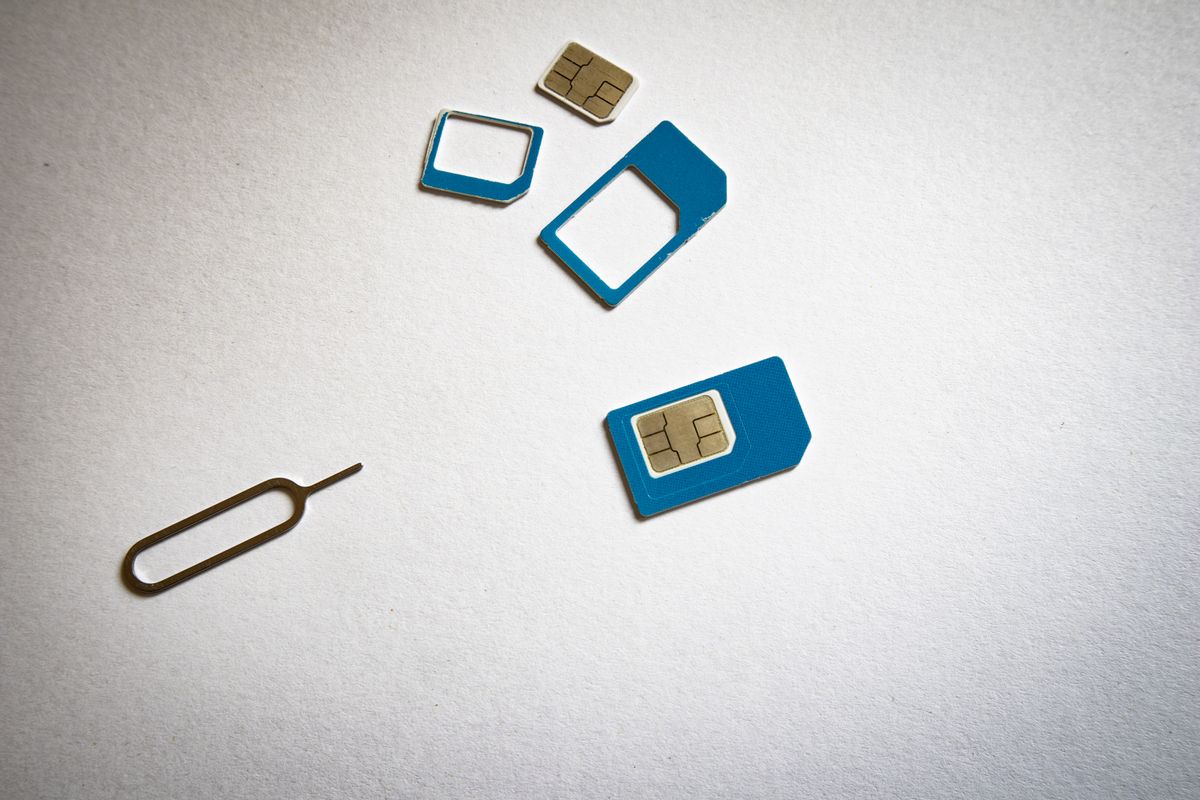
The physical SIM sizes are set by ETSI, the European standards body behind the SIM specification (ETSI TS 102 221). Each size has a "form factor" name, from 1FF to 4FF:
| SIM type | Also called | Size | Used in |
|---|---|---|---|
| Full-size SIM | 1FF | Credit card size (85.6 × 54 mm) | The first mobile phones, not used today |
| Mini SIM | Standard SIM, 2FF | 25 × 15 × 0.76 mm | Older phones |
| Micro SIM | 3FF | 15 × 12 × 0.76 mm | iPhone 4 and 4s, and other older phones |
| Nano SIM | 4FF | 12.3 × 8.8 × 0.67 mm | iPhone 5 and later, and most current Android phones |
| eSIM | Embedded SIM, eUICC | A chip built into the phone, no card | iPhone XS and later, Galaxy S20 and later, many recent phones |
| iSIM | Integrated SIM | Part of the phone's main processor | Devices whose processor supports it |
The chip itself is about the same on the mini, micro and nano SIM. Only the plastic around it is smaller. That's why one SIM can be sold in several sizes at once.
Full-size SIM (1FF)
The original SIM was as big as a bank card. You won't find it in phones anymore, but a new SIM card often still comes in a frame of this size: you pop the SIM out of it.
Mini SIM, or "standard SIM" (2FF)
When people say "standard SIM" or "regular SIM", they mean the mini SIM: 25 × 15 mm. It was the usual size in mobile phones for many years and is now mostly found in older phones.
Micro SIM (3FF)
The micro SIM is 15 × 12 mm, with the same thickness as the mini SIM. Apple used it in the iPhone 4 and iPhone 4s, and in the first iPads with mobile data (Apple: which SIM your iPhone or iPad uses).
Nano SIM (4FF): what does nano SIM mean?
Nano SIM means the smallest SIM card size: 12.3 × 8.8 mm, and only 0.67 mm thick. When ETSI approved it in 2012, it was 40% smaller than the smallest SIM before it (ETSI). It's the SIM card used in every iPhone with a SIM tray since the iPhone 5, and Samsung calls it the size "used by most new phones" (Samsung: SIM cards for your Galaxy).
Trio SIM and multi-size SIM cards
A trio SIM (also called triple SIM or 3-in-1 SIM) is one SIM card cut into all three sizes: you press out the mini, micro or nano SIM, whichever your phone needs (T-Mobile: Triple SIM). Many carriers now send their SIM cards like this. Have an older card that's too big? Ask your carrier for a new SIM, or read how to cut a SIM card to nano or micro size and its risks first.
Which SIM card does my phone use?
Most phones in use today take a nano SIM, and many also have an eSIM. Some recent models no longer have a SIM tray at all. Here's what the makers say.
iPhone
- Original iPhone, iPhone 3G and 3GS: mini SIM.
- iPhone 4 and 4s: micro SIM.
- iPhone 5 to iPhone X, and iPhone SE (2nd generation): nano SIM only.
- iPhone XS, XR and later: nano SIM and eSIM.
- eSIM only: the iPhone Air everywhere. iPhone 14, 15 and 16 series and iPhone 16e models bought in the United States. And iPhone 17, 17e, 17 Pro, 17 Pro Max, 18 Pro and 18 Pro Max models bought in the US, Canada, Mexico, Japan, the UAE, Saudi Arabia and a few other countries.
So an iPhone 17 bought in the UK, India or the Philippines still has a nano SIM tray plus eSIM, while the same model bought in Canada is eSIM only (Apple).
Samsung Galaxy SIM card compatibility
Current Galaxy phones take a nano SIM. Samsung lists two ways to use two lines (Samsung):
- Nano SIM and eSIM: Galaxy S20 to S26 series, Galaxy Note20, Galaxy Z Fold2 and later, Galaxy Z Flip3 and later, plus some A series models.
- Two nano SIMs: for example the Galaxy S20 FE and S21 FE, and several A series phones, on unlocked models.
Samsung also says that eSIM may not be supported depending on the country your phone comes from, and that some carriers don't support it yet. The easiest check is Settings > Connections > SIM manager: if you see Add eSIM, your Galaxy supports eSIM.
Google Pixel
The Pixel 10 sold in the UK has one nano SIM slot plus eSIM (Google Store UK: Pixel 10 specs). The Pixel 10 sold in the US has no SIM slot: it uses two active eSIMs (Google Store US: Pixel 10 specs).
How to check your own phone
- Look at the SIM tray or the spec page of your model.
- Dial *#06#. If you see an EID number, your phone has an eSIM. More ways to check eSIM compatibility.
- Check the list of eSIM supported phones by brand and model.
eSIM and iSIM: SIM types without a card
eSIM
An eSIM (embedded SIM) is a SIM chip built into your phone. You don't insert anything: you download your mobile plan to it, usually by scanning a QR code. The GSMA, the mobile industry body, wrote the standard that lets carriers send plans to an eSIM over the internet (GSMA SGP.22). One eSIM can hold several plans, so you can switch between your home line and a travel plan in your settings.
iSIM
An iSIM (integrated SIM) goes one step further. The SIM isn't a separate chip anymore but part of the phone's main processor. In 2023, Thales and Qualcomm announced the first GSMA-certified iSIM on a smartphone processor. It uses the same GSMA remote provisioning as the eSIM, so you add plans to it the same way (Thales). Learn more about what an iSIM is.
When can an eSIM replace your SIM card?
An eSIM can do the same job as a physical SIM. You can use one instead of a SIM card when:
- Your phone supports eSIM and isn't locked to another carrier.
- Your carrier offers eSIM. Many carriers do, so ask yours. Then see how to convert your physical SIM to an eSIM. You keep the same number.
- Your phone is eSIM only. On the eSIM-only models listed above, you don't have a choice: your plan has to be an eSIM.
- You're travelling. Keep your home SIM in the tray and add a travel eSIM for data abroad. No new card to find when you land.
Using a SIM card and an eSIM together (dual SIM)
Phones with a nano SIM and an eSIM can use both at the same time. On iPhone XS and later, each line has its own number for calls and texts, but only one line uses mobile data at a time. From the iPhone 13, two eSIMs can also be active at once (Apple: Dual SIM with eSIM). That's how you can keep your home number for calls and texts, and use a travel eSIM for the internet. More on how dual SIM works.
Travelling around Asia, for example to India, the Philippines, Bangladesh or the UAE? This data-only eSIM covers 26 countries in Asia and the Middle East. It installs from a QR code in your email and works on unlocked, eSIM-compatible phones.
Going to Europe, the USA or Canada? Pick a data-only eSIM and keep your SIM card for your home number.
Europe, USA and Canada plans shown · data-only eSIMs, no phone number · Find the eSIM for your destination
FAQs
What does SIM card mean?
SIM stands for Subscriber Identity Module. It's the chip that identifies your mobile subscription to your network, so you can make calls, send texts and use mobile data.
How many types of SIM cards are there?
There are four physical SIM sizes: full-size, mini (the "standard SIM"), micro and nano. On top of that come the eSIM, built into the phone, and the iSIM, built into the phone's processor. Phones today use the nano SIM, the eSIM, or both.
What is a nano SIM?
A nano SIM is the smallest SIM card: 12.3 × 8.8 mm and 0.67 mm thick. It's the SIM size used in iPhones since the iPhone 5 and in most current Android phones.
What is a trio SIM?
A trio SIM is a single SIM card that you can press out in three sizes: mini, micro or nano. You pick the size that fits your phone. Your number stays the same whichever size you use.
Are all SIM cards the same?
No. They come in different sizes, and a SIM is linked to one carrier and one account. If your phone is locked to a carrier, a SIM from another carrier won't work in it. Since most SIM cards are now multi-size, the size is rarely a problem.
What's the difference between a SIM card and an SD card?
A SIM card connects your phone to a mobile network. An SD card (or microSD card) only adds storage for photos, videos and files. Some phones have one tray that holds both.
Can an eSIM replace my nano SIM?
Yes, if your phone supports eSIM and your carrier offers it. Your carrier moves your number to the eSIM, and you no longer need the SIM card. On eSIM-only phones, it's the only option.
Do all phones need a SIM card?
To use a mobile network, a phone needs a SIM or an eSIM. Some older CDMA phones worked without a SIM card. Read more about the difference between CDMA and GSM.